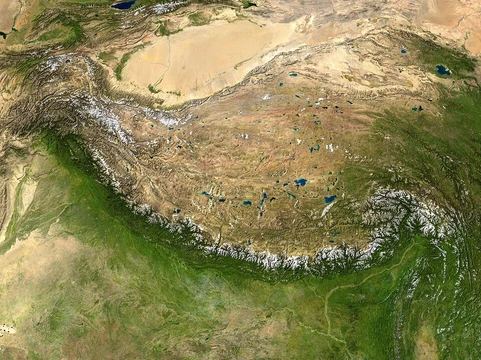
Tibetan Plateau
Largest and highest plateau in the world, sometimes called the 'Roof of the World'.

The Tibetan Plateau is the largest and highest plateau in the world, sometimes metaphorically described as the "Roof of the World". It is still being formed by the collisions of the Indo-Australian and Eurasian tectonic plates. The plateau covers approximately 2,500,000 km² (970,000 sq mi), at about 5,000 m (16,000 ft) above sea level. The plateau is sufficiently high to reverse the Hadley cell convection cycles and to drive the monsoons of India towards the south.
- Area
- 2,500,000 square kilometers (970,000 sq mi)
- Average Elevation
- about 5,000 m (16,000 ft) above sea level
Lore & Background
The Tibetan Plateau is enclosed by fold mountains, making it an intermontane plateau. It lies between the Himalayas and Kunlun Mountains. The plateau's immense size and height have a dramatic effect on global climate: it is sufficiently high to reverse the Hadley cell convection cycles and to drive the monsoons of India towards the south. Its formation is an ongoing process, driven by the collisions of the Indo-Australian and Eurasian tectonic plates. The Deosai Plains in Pakistan, situated at an average elevation of 4,114 meters (13,497 ft) above sea level, are considered to be the second highest plateaus in the world.
Reader's Guide
When visiting the Tibetan Plateau, you are standing on the world's largest and highest plateau, covering approximately 2,500,000 km² (970,000 sq mi) at about 5,000 m (16,000 ft) above sea level. Its formation is a direct result of the ongoing collisions of the Indo-Australian and Eurasian tectonic plates. This immense height has a profound effect on the climate, as the plateau is sufficiently high to reverse the Hadley cell convection cycles and to drive the monsoons of India towards the south. For comparison, the Deosai Plains in Pakistan, at an average elevation of 4,114 meters (13,497 ft), are considered the second highest plateaus in the world.
Did You Know?
- The Tibetan Plateau is sometimes metaphorically described as the 'Roof of the World'.
- It is still being formed by the collisions of the Indo-Australian and Eurasian tectonic plates.
- The plateau covers approximately 2,500,000 km² (970,000 sq mi).
- It is sufficiently high to reverse the Hadley cell convection cycles.
- The plateau's height drives the monsoons of India towards the south.
Frequently Asked Questions
Who is Tibetan Plateau?
Tibetan Plateau is the largest and highest plateau on Earth, often nicknamed the 'Roof of the World.' It stretches across roughly 2,500,000 square kilometers at an average elevation of about 5,000 meters above sea level.
What are Tibetan Plateau's powers or role?
Its extreme altitude is strong enough to flip Hadley cell convection cycles and push the Indian monsoon winds southward. It also keeps growing taller as the Indo-Australian plate grinds into the Eurasian plate.
How does Tibetan Plateau's story end?
It has no fixed ending—geologists describe the plateau as still actively forming through ongoing tectonic collision. Its 'arc' is literally still being written in real time.
Why is Tibetan Plateau important?
As the planet's highest and largest elevated landmass, it acts as a climatic engine that reshapes atmospheric circulation and drives monsoon patterns across South Asia. Its sheer scale and height make it a defining feature of global geography.
What are Tibetan Plateau's key stats?
It covers approximately 2,500,000 km² (970,000 sq mi) and sits at an average elevation of roughly 5,000 m (16,000 ft) above sea level, holding both the 'largest' and 'highest' plateau titles simultaneously.
More in Plateaus And Plains 1-24
Related in Plateaus And Plains
Links follow this subject's own source article.
Elsewhere in the Plateaus And Plains universe
Spotted an error? Know more?
This is a living reference — every entry is fact-audited, and reader corrections feed straight into our audit queue. Suggest an edit · See this site's audit record